
The Hidden Cost Nobody Talks About
Cardboard boxes feel cheap. You walk into Home Depot or Lowe’s, grab a stack, and think you’re being smart with your money. At around $3.78 or $3.85 per box, it doesn’t feel like a big deal in the moment. It’s just a few bucks here and there, right? But moving doesn’t happen in a vacuum. You’re not buying 3 boxes. You’re buying 30, 50, sometimes 80 depending on the size of your home in Carmel, Fishers, or Zionsville. That’s where things start to get a little ridiculous.
Imagine standing in your garage surrounded by a pile of flattened cardboard that cost you $200 to $300 total. Now imagine doing absolutely nothing with it after your move. That’s the part people don’t think through. You don’t reuse them. You don’t resell them. Most of them are bent, torn, or just gross after one move. So what did you actually pay for? A temporary container that lasted a couple of weeks.
That’s not saving money. That’s lighting it on fire slowly.
What You’re Really Paying Per Box
Let’s actually run it in a way people understand. If you spend $3.85 per box and use it once, your cost per use is $3.85. Simple enough. Now compare that to a moving tote rental where the average cost per tote lands closer to $3.55 for the entire rental period.
At first glance, those numbers feel close. Close enough that people shrug and stick with cardboard. But here’s the twist that flips the whole thing.
With a tote, you can use it multiple times during your move.
Pack your kitchen. Move it. Unload it. Then take those same totes and pack your garage or your closets. That one tote just replaced two or three cardboard boxes. Your effective cost per use drops fast. Now you’re not paying $3.55 per tote. You’re paying closer to $1.50 or even less depending on how you use them.
Try doing that with cardboard. You can’t. Once that box is taped, cut, crushed, or damp from sitting in a garage overnight, it’s done. You’re not rotating it through your house like some kind of reusable system. It’s a one-and-done deal.
The Tape Problem Nobody Budgets For
Here’s where cardboard quietly drains your wallet again. Tape.
You don’t just buy boxes. You buy tape. And not one roll. You end up with two or three because every single box needs to be assembled, sealed, and reinforced. The bottom gets taped. The top gets taped. Then you double-tape the heavy ones because you don’t trust them.
Now picture doing that 50 times.
It’s not just the cost. It’s the time. You’re sitting on your floor building boxes like you’re working a part-time warehouse job. Meanwhile, your kids are asking where their toys are and your spouse is wondering why the move hasn’t started yet.
With totes, the lid is attached. You snap it shut and you’re done. No tape gun. No wasted time. No extra trip back to the store because you ran out halfway through packing your pantry.
Stacking: Cardboard vs Real-World Physics
Cardboard boxes love to collapse at the worst possible moment. You know the scenario. You’ve got a stack going in the garage or the back of your truck. Everything looks fine until that one slightly weaker box gives out. Suddenly your stack leans, then shifts, then you’re catching falling boxes full of dishes like you’re in some kind of game show.
Totes don’t play that game.
They’re designed to stack. They lock into place. You can go five high without wondering if gravity is about to ruin your day. When you’re loading a truck in Westfield or hauling things across town to Noblesville, that stability matters more than people realize. It’s not just about convenience. It’s about not breaking your stuff.
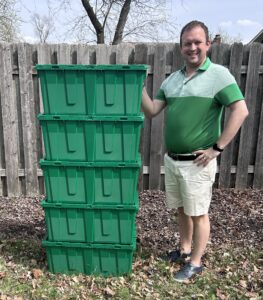
See! Like this, with this dashing fellow.
Weather Doesn’t Care About Your Cardboard
Indiana weather is unpredictable. One minute it’s sunny, the next minute you’re dealing with humidity, drizzle, or that random light rain that shows up just long enough to ruin your boxes.
Cardboard absorbs moisture. It softens. It warps. It starts to feel like a bad idea halfway through your move.
Now imagine you packed books, electronics, or clothes in those boxes.
Totes don’t absorb anything. Rain hits them and rolls off. You wipe them down and keep moving. It’s one less variable to worry about on a day that already has plenty of chaos.
Time Is Money, and Cardboard Wastes Both
People underestimate how long it takes to deal with cardboard. Not just packing. Everything around it.
You have to:
Build every box
Tape every seam
Label everything clearly
Break everything down afterward
Figure out where to dump or recycle it
That’s hours of work you don’t get back.
With totes, you pack them, move them, and when you’re done, they get picked up. No breakdown. No recycling run. No stacking flattened boxes in your garage for three weeks while you “figure out what to do with them.”
The Clutter Problem After the Move
Nobody talks about this part, but it’s real.
After the move, you’re tired. Your house is half set up. And now you’ve got a pile of empty cardboard taking up space in your garage or living room. You don’t want to deal with it. So it sits there.
A week goes by. Then two.
Eventually, you either break it down or throw it out, but it becomes one more annoying task hanging over your head.
With totes, they leave. That’s it. Pickup happens, and your space is clean again. No leftovers. No cleanup project.
If you’re planning your move right now, the tote pricing page gives a simple breakdown of what most homes actually need, so you’re not guessing how many containers to get.
Cardboard Only Works Once. Totes Work Like a System.
This is where people finally start to see the difference.
Cardboard is a product. You buy it, use it, throw it away.
Totes are a system.
You rotate them through your house. You pack by zone. You move things in phases instead of trying to do everything at once. It turns a chaotic move into something that actually feels manageable.
Picture packing your kitchen on Monday, moving it Tuesday, then reusing those same totes for your basement on Wednesday. That’s how people move faster without feeling overwhelmed.
If you’re new to this idea, the Why Totes guide breaks it down in a way that actually makes sense without overcomplicating it.
What This Looks Like in a Real Indy Move
Let’s say you’re moving from a 3-bedroom house in Carmel to a new place in Fishers.
You need around 50 containers to move everything comfortably.
If you go cardboard, you’re buying 55 boxes at roughly $3.85 each. That’s about $212 before tape, before replacements for damaged boxes, before anything else.
Now compare that to renting 55 totes at roughly $3.55 per unit for the rental period. You’re already spending less upfront. But then you reuse those totes during your move, effectively cutting your cost per use in half or better.
You also skip tape. You skip assembly. You skip disposal.
So the question isn’t really “which one is cheaper on paper.” It’s which one actually costs less when the move is over and done. Even if it was merely about “what works on paper”, our totes still win.
So Yeah… Cardboard Isn’t the Bargain People Think
Cardboard feels cheap because the price per box is low. But when you zoom out and look at the full picture, it’s a short-term solution that creates more work, more waste, and more hidden costs.
Totes flip that model. You’re not buying something to throw away. You’re using something designed to make the entire move easier, faster, and honestly less frustrating.
And if you’ve ever had a box break in your hands halfway up a staircase, you already know which option sounds better.

0 Comments